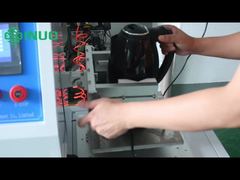
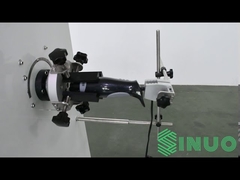
Brief: Watch our dynamic demo of the Single Handle Cookware Torque Resistance Test Equipment in action. This video provides a clear walkthrough of how to perform torque resistance testing according to EN 12983-1:2023 standards, showing you the step-by-step operation procedure and how to interpret the results for reliable handle performance evaluation.
Related Product Features:
Engineered to meet EN 12983-1:2023 clause 7.8 and Appendix C requirements for comprehensive torque resistance testing.
Features a 1-meter long balance lever with 1±0.1kg weight for precise torque application and measurement.
Equipped with upper and lower V-shaped handle clamps that securely lock cookware handles during testing.
Measures torsion deformation with a scale resolution of 1° to ensure it does not exceed the 10° limit.
Verifies that fasteners remain secure after testing without compromising handle functionality.
Compact equipment dimensions of 700mm × 505mm × 630mm for efficient laboratory use.
Configured to match client's local power supply requirements for global compatibility.
Includes a detailed operation procedure for accurate and repeatable test results.
Domande frequenti:
What standard does this torque resistance test equipment comply with?
This equipment is engineered to meet EN 12983-1:2023 clause 7.8 and Appendix C, figure C.1 requirements for handle torque resistance testing.
How does the equipment measure handle deformation during testing?
The equipment uses a balance lever with weights and a scale with 1° resolution to measure torsion deformation, ensuring it does not exceed 10° in any direction.
What is the purpose of the V-shaped handle clamps?
The upper and lower V-shaped handle clamps are designed to securely lock the cookware handle at the midpoint during testing, preventing slippage and ensuring accurate torque application.
What preparations are needed before conducting the torque test?
Before torque testing, preliminary heat resistance testing must be conducted on samples according to Appendix B requirements, and the apparatus must be positioned on a level, flat surface.